• Skip to main content
  • Skip to footer
  • E-mail
  • LinkedIn
  • Phone
  • YouTube

Harvey Planning Consultancy

  • Services
    • Pre-Construction Planning Management
    • Project Controls During the Construction Phase
    • Forensic Schedule Delay Analysis
    • Other Industries
    • Technologies
  • About
    • What We Do
    • How Does It Work?
    • Consultants
    • Client Focus
    • Operations
    • Projects
  • Library
    • Planning & Scheduling
      • Chronicle of Planning
      • History of Critical Path Method
      • Precedent Networks
      • Planning Terminology
      • Planning Hierarchy
      • Strategic and Tactical Planning
    • Work Study Introduction
    • Productivity & Production Rates
    • Earned Value Analysis
    • Forensic Schedule Delay Analysis
      • Summary of Procedures for building a claim
      • Scott Schedule
      • Construction Delay Terminology
    • Procurement Routes for the Construction Industry
    • Documentation
      • Forms of Contract
    • Quotations
  • Contact
  • Blogs
    • Studying the Past to Reveal the Future
    • The History of Banking and What the Future Holds
    • Civil Engineering
    • Architects
  • Book

Michael Harvey

Civil Engineering Pt3

24 June 2021 By Michael Harvey Leave a Comment

The third part in this series is devoted to another great civil engineer Isambard Kingdom Brunel.  

Not only was he a civil engineer, but also a structural and marine engineer.

Brunel was one of the most versatile and audacious engineers of the 19th century, responsible for the design of tunnels, bridges, railway lines and ships.

Isambard Kingdom Brunel was born on 9 April 1806 in Portsmouth. His father Mark was a French engineer who had fled France during the revolution. Brunel was educated both in England and in France.

When he returned to England he went to work for his father. Brunel's first notable achievement was the part he played with his father in planning the Thames Tunnel from Rotherhithe to Wapping, completed in 1843.

In 1831, Brunel's designs won the competition for the Clifton Suspension Bridge across the River Avon. Construction began the same year, but it was not completed until 1864, Brunel died on 15 September 1859 (aged 53)

My third choice of civil engineering wonders is the Clifton Suspension Bridge which commenced construction on 21st June 1831 and took 33 years to complete.

A reason as to why the bridge took so long to construct was that an attempt to build Brunel's design was halted by the Bristol riots, and the revised version of his designs was built after his death and completed in 1864.
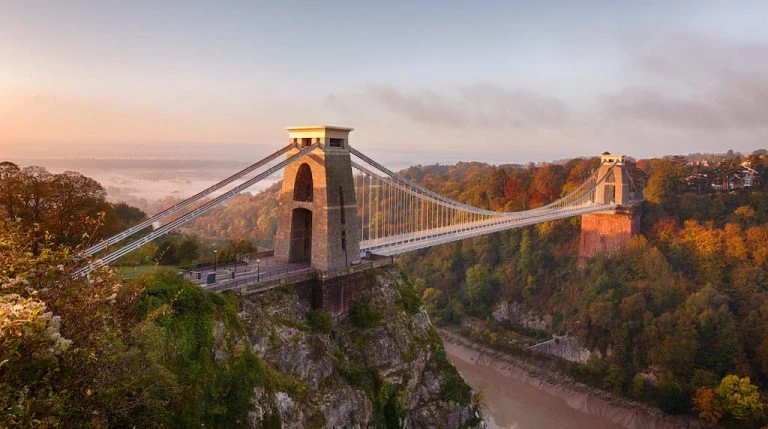
Clifton Suspension Bridge

The revised design was made by William Henry Barlow and Sir John Hawkshaw, with a wider, higher, and sturdier deck than Brunel intended, with triple chains instead of double.

Although similar in size, the bridge towers are not identical in design, the Clifton tower having side cut-outs, the Leigh tower more pointed arches atop a 110-foot (34 m) red sandstone-clad abutment. Roller-mounted "saddles" at the top of each tower allow movement of the three independent wrought iron chains on each side when loads pass over the bridge. The bridge deck is suspended by 162 vertical wrought-iron rods in 81 matching pairs.


Filed Under: Blog

Civil Engineering Pt 2

23 June 2021 By Michael Harvey 2 Comments

In writing this paper I am reminded of many great civil engineering projects, but who were the people behind these great projects?

The father of civil engineering was John Smeaton.

John Smeaton

John Smeaton was an Englishman the first self-proclaimed civil engineer, often regarded as the “father of civil engineering.” Smeaton was born in Austhorpe, Leeds, England on June 8, 1724.

John Smeaton was a pioneer in the use of cast iron in water and windmill mechanisms. It was the President of the Royal Society who recommended John to design the Eddystone Lighthouse.

Recommended by the Royal Society at the age of 30, Smeaton designed the third Eddystone Lighthouse after the previous structure was destroyed by fire. He pioneered the use of hydraulic lime, a form of mortar that will set underwater, and developed a technique involving dovetailed blocks of granite in the building of the lighthouse. He also developed a method to raise the blocks from a movable floating base 60 feet in the air, so that the stones could be placed atop the lighthouse.

One of my favourite civil engineering projects would be the third Eddystone Lighthouse, no doubt many will disagree with my choice, however, such an undertaking in such dangerous conditions of the time took remarkable ingenuity and nerve.

About Eddystone Lighthouse

Height: 49 m

Opened: 18 May 1882

Material: Wood

Automated: 1982

Owner: Trinity House

Range: 17 nautical miles (31 km)

Third Eddystone Lighthouse

Smeaton was responsible for the development of modern cement, having identified the compositional requirements needed to obtain hydraulicity in lime, work which led ultimately to the invention of Portland cement. His lighthouse remained in use until 1877. After the rock underlying the structure’s foundations began to erode, it was dismantled and partially rebuilt at Plymouth Hoe where it is known as Smeaton’s Tower.

Eddystone Lighthouse 2021

The current Eddystone Lighthouse is the fourth to be built on the site (or the fifth, since the first lighthouse was substantially rebuilt after only a year due to harsh conditions). The first lighthouse (Winstanley's) was swept away in a powerful storm, killing its architect and five other men in the process. The second (Rudyard's) stood for fifty years before it burned down. The third (Smeaton's) is the best known, renowned because it influenced lighthouse design and its importance in the development of concrete for building; its upper portions were re-erected in Plymouth as a monument. The first lighthouse, completed in 1699, was the world's first open ocean lighthouse, although the Cordouan Lighthouse off the western French coast preceded it as the first offshore lighthouse.

Blog revised 29th November 2021

Filed Under: Blog

Civil Engineering Part 1

22 June 2021 By Michael Harvey Leave a Comment

What does a Civil Engineer do?

Civil engineers conceive, design, build, supervise, operate, construct, and maintain infrastructure projects and systems in the public and private sector, including roads, buildings, airports, tunnels, dams, bridges, and systems for water supply and sewage treatment.

The term engineering comes from two Latin words: ingenium, meaning “cleverness” and ingeniare, meaning “to devise”. For centuries, mankind has been using its intelligence to conceive, design and construct things which help us to solve life’s problems. There are many great civil engineering projects across the globe.

If I were to name my favourite civil engineering project, it would be the Westway in London where I was employed as a young civil engineer working for John Laing Construction.

In its time in the UK the Westway was lauded as an exceptional fete of civil engineering.

The Westway was funded by the GLC with a 25% grant from central government.

The main contractor was John Laing & Sons, while the flyovers at the eastern end were engineered by Sir Bruce White and Partners.

Every engineer will have a different opinion on the most impressive creations, however, in a series of papers I am declaring my favourite ten civil engineering projects which rate as being unsurpassable.

My number one on the list must be Great Pyramid of Giza

Great Pyramid of Giza

The Great Pyramid—the oldest, largest, and most famous of the monuments—is the last of the ancient world's "seven wonders" still standing. ... Today the Great Pyramid stands at 450 feet.

Built mainly of limestone, mortar, some granite in .

Image of Giza Pyramid

The Great Pyramid was built by quarrying an estimated 2.3 million large blocks weighing 6 million tonnes total. Most stones are not uniform in size or shape and are only roughly dressed. The outside layers were bound together by mortar. Primarily local limestone from the Giza Plateau was used. It remains largely undamaged. It is the largest of the three pyramids in the Giza pyramid complex and was the tallest construction in the world for over 3,800 years.

It is believed that the pyramid was built as a tomb for the fourth Dynasty Egyptian pharaoh, Khufu and was constructed over a twenty-year period.

Filed Under: Blog

THE PLANNING ENGINEER

19 June 2021 By Michael Harvey 3 Comments

What is the role of a planning engineer?

Planning engineers determine and develop the most suitable and economically viable construction and engineering methods for projects. ... It is the responsibility of the planning engineer to estimate a timescale for a project and to ensure that key milestones are met.

Planning Engineer Skills

The Planning Engineer normally possess all the skills of being able to run a project and therefore take on the role of project manager should the need arise.

The Planning Engineer will have strong multitasking abilities.

The Planning Engineer will have strong analytical, critical, and logical thinking skills and the ability to focus under pressure.

The Planning Engineer will have strong communication skills.

The Planning Engineer will have a sound knowledge of health and safety protocols.

The Planning Engineer becomes the focal point in producing reports which relay to the team and the Client the important questions of:

  • Where are we?
  • What has it cost to get there?
  • Where are we going?
  • How can we correct any problems?

Many companies still believe that project planning is, and the planning engineer is an unnecessary overhead. Nothing could be further from the truth.

A good planning engineer will save a project from being hamstrung by inefficiencies and needless expenses and undoubtedly improve the bottom line.

Filed Under: Blog

THE PROJECT PLANNER AND THE KEYBOARD JOCKEY

18 June 2021 By Michael Harvey 2 Comments

Project planning is Project Management and I defy anyone who says it is not.

Project Planning is a career path that holds a seat awfully close to the top echelons of any company.

Project Planning should begin at the inception of any project and becomes the pre-engineering process where nothing is left to chance when it comes to the construction phase.

The Planning Engineer is the focal point when the questions are asked.

•             Where are we? - Progress Update

•             What has it cost to get here? - Overruns on Programme cost, time, and money.

•             Where are we going? - Slippage in programme = Compensable vs. Non-Compensable Delays

•             How can we correct any problems? = Create an action plan

Of course, enthusiasm and recognition within the company is the real key that helps to motivate and excite the Planning Engineer.

Whether the project is to construct world’s tallest building, or the construction of an elevated motorway, project planning and scheduling is quite simply the beating heart of every project.

“In essence the effectiveness of a planning engineer may be divided into three essential components:

• Technical skills – planning engineers need an understanding of fundamental techniques, processes, and software related skills (though the former area should be far more heavily weighted).

• The amount of site visits! - How familiar are they with the aspect of the project schedules they typically prepare.

After all, how is it possible to analyse risk, opportunity, and the project delivery strategy when you have no understanding of the work composition that underpins each of the project events?

• Personal characteristics - Though a more difficult area to address, it is their personal characteristics that will typically win the day. Effective planning engineers are usually intrusive, engaging, good communicators, perhaps pessimistic (or they should be to balance out the naturally optimistic project managers!) and of course good team players.”

The Keyboard Jockey

The keyboard jockey is somebody who talks big about the subject of planning and scheduling but cannot back their words up with real life accomplishments in the industry.

He or She may well know their way around the software, however, they do not come under the category of a Planning Engineer who approaches the project in an eclectic manner.

The keyboard jockey will not add value to his role as he lacks the upbringing of a planning engineer.

The planning engineer will have served and alternated his time during training in many departments, thus, acquiring an appreciation for tendering and estimating department site engineering, quantity surveying etc.

Filed Under: Blog

  • « Go to Previous Page
  • Page 1
  • Interim pages omitted …
  • Page 8
  • Page 9
  • Page 10

Footer

Based in Ireland

Tel:

Email: [email protected]

  • E-mail
  • LinkedIn
  • Phone

Harvey Planning Consultancy


Terms and Conditions

Copyright © 2024 ·Harvey Planning Consultancy · Site by Maloney IT · Customer Portal

Scroll Up